
Free Spins Casino India Guide to Value, Wagering and Traps
Spin offers are the most common casino promotion advertised to Indian players, usually presented as a number in large type: 50, 100 or 200 spins. What that number is worth depends on the stake of each spin, the slot it is tied to, the wagering attached to the winnings, the cap on what can be withdrawn and the expiry date. This guide explains how such offers work, how to calculate their real value in rupees, which terms quietly remove most of it, and why such offers fall under the 2025 ban on online money games in India.

How free spins offers work
A spin offer gives a set number of rounds on a slot without taking money from the player's balance for each spin. The casino pays for those rounds as a marketing cost, and it recovers that cost through the conditions attached to the winnings. Understanding the offer therefore means looking past the spins themselves to what happens to any money they produce, which is where almost all of the real terms sit.
Spin value and eligible games
Every free spin has a fixed stake set by the casino, often the lowest bet on the chosen slot, such as ₹8 or ₹10 per spin. Multiplying the number of spins by that stake gives the face value of the offer, so 100 spins at ₹10 are worth ₹1,000 in stakes, not 100 chances at a jackpot. The spins are usually locked to one slot or a short list, and that slot's return to player matters, because a lower-RTP version returns less on average from the same spins, and the terms rarely say which version is used.
How winnings are credited
Winnings from these rounds are rarely paid as cash. In most cases they land in a bonus balance that carries its own wagering condition, a maximum amount that can be converted to cash and a deadline. Some casinos credit the winnings as cash with no wagering, which is far more valuable, but those offers are usually smaller in headline size. The difference between the two types can be larger than the difference between 50 and 200 spins, so the crediting rule is the first clause to look for.
Types of free spins offers
Offshore casinos aimed at India package spins in several ways, and each type tends to come with its own pattern of conditions. Knowing which kind of offer is on screen makes it easier to find the clauses that matter. The main types seen across the reviewed brands, and the first condition to check for each, are summarised below:
| Type of offer | How it is triggered | Condition to check first |
|---|---|---|
| No deposit free spins | Registration or a code, without paying in | Maximum cashout, often a small fixed amount |
| Deposit free spins | A qualifying first or later deposit | Minimum deposit and eligible payment methods |
| Welcome package spins | Spread across several deposits with a match bonus | Whether wagering applies to the deposit as well |
| Reload or weekly spins | Recurring deposits or loyalty status | Short expiry, often 24 to 72 hours |
| Game launch spins | Promotion of a new slot from a studio | Which slot version and RTP the spins use |
No deposit free spins look like the safest option, since no money is paid in, but they usually carry the tightest caps and the heaviest wagering, and they are also the offer most often used to collect personal data and phone numbers for marketing. The no deposit bonus guide covers that category in more detail.
Working out what free spins are worth
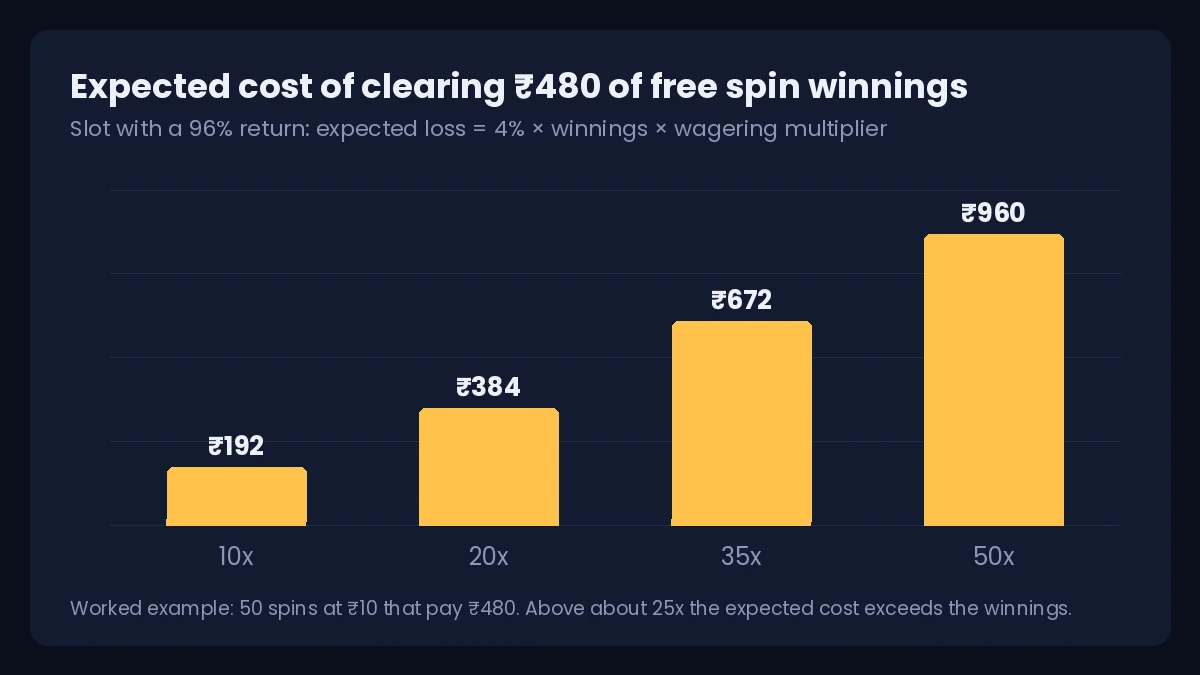
The value of a spin offer can be estimated in a few steps using numbers that appear in every set of terms. The calculation does not predict any individual result, since slots are random, but it shows what the offer is worth on average and whether the conditions make it worth accepting at all. The chart shows how quickly wagering eats into a typical amount of free spin winnings:
- multiply the number of spins by the stake per spin to find the face value;
- multiply the face value by the slot's RTP to estimate the average winnings;
- multiply those winnings by the wagering requirement to find the total amount to stake;
- multiply the total stake by the house edge to estimate the expected cost of wagering;
- subtract that cost from the winnings and apply any cap on cashout.
If the result is close to zero or negative, the spins have little real value, however large the headline number. A result well above zero usually means low wagering or none at all, which is the sign of a genuinely useful offer. Running the five steps takes a couple of minutes with the terms open and a phone calculator.
A worked example in rupees
Take 50 spins at ₹10 on a slot with a 96% return. The face value is ₹500 and the average winnings are about ₹480. With a 35x wagering requirement on the winnings, the player must stake ₹16,800 before withdrawing. At a 4% house edge, the expected loss over that volume is about ₹672, which is more than the ₹480 being cleared. On average, the offer is worth nothing once the wagering is completed, even before any cap on cashout is applied. At 10x the same spins would keep about ₹290 of value.
When wagering wipes out the value
On a slot with a 4% edge, the expected cost of wagering equals the winnings at 25x. Below that level, some value usually survives; above it, the average player loses the winnings and often part of their own balance while trying to clear them. That is why spins with 10x wagering can be worth more than twice as many spins at 40x, and why spins credited as cash, with no wagering at all, are the most valuable form of the offer by a wide margin, even when the headline number is small and the slot is a modest one.
Terms that decide whether free spins pay
Beyond the wagering multiplier, a handful of clauses determine how much of a spin balance can ever become withdrawable money. They are usually found in the general bonus terms rather than on the promotion page itself, and each of them can reduce the value of an offer sharply, sometimes to nothing, without any change to the headline.
Maximum cashout and expiry
Many spin offers cap the amount that can be withdrawn from their winnings, for example at ₹1,000 or ₹5,000, regardless of how much the spins actually produced. Anything above the cap is removed when the bonus converts to cash. Expiry rules work in two stages: the spins themselves must be used within a set time, often a day or a few days, and the resulting bonus must then be wagered before a second deadline, after which the whole balance disappears, including any part already wagered.
Maximum bet and game weighting while clearing
While a spin balance is being wagered, most casinos limit the stake per spin or hand, and a single bet above that limit can void all bonus winnings. Games also count at different rates towards the wagering requirement: slots usually count in full, while live casino tables, roulette and crash games may count at a small percentage or not at all. Some terms also exclude specific high-RTP slots from wagering, which pushes play towards games with a larger house edge and a higher expected cost.
Free spins at the brands reviewed on this site
Every brand reviewed on Best Casino India advertises spins in some form, usually as part of a welcome package. Rajabets and Betmaan promote multi-stage welcome offers with spins attached, 22Bet and Dafabet include free spins in some of their regional casino promotions, and BC.Game mixes spins with crypto rewards and rakeback. The exact figures change often and differ between site versions, so the reviews describe the structure of each offer rather than repeating a headline number that may already be out of date.
Across all five brands the same pattern appears, whatever the size of the headline figure, the slot chosen or the design of the promotion page. The reviews flag the points where it most often catches players out, and they are worth checking in this order, with the terms page open, before a single spin is used:
- spins tied to selected slots chosen by the casino rather than the player;
- winnings credited to a bonus balance instead of cash;
- a separate wagering requirement and deadline for that balance;
- a cap on how much of the winnings can ever be withdrawn.
These conditions, not the number of spins, decide the value of each promotion, and a short offer with cash winnings can easily beat a long one with a low cap and heavy wagering. The casino comparison sets out the main caution for each brand, and the welcome bonus guide explains how spins combine with deposit matches in a package.
The legal position of free spins offers in India
Spin offers are a promotion for an online money game, and in India both the game and its promotion are now banned. Under the 2025 gaming law, a company that runs such games risks a three-year sentence and a ₹1 crore fine, a promoter risks two years and ₹50 lakh, and payment firms are barred from moving the money. Enforcement began when the implementing rules took effect in May 2026, overseen by a new Online Gaming Authority of India.
For a player, this means that a spin offer from an offshore casino comes with no protection at all. If winnings are withheld or an account is closed, there is no Indian authority to complain to, and the deposits needed to unlock most offers would have to go through payment routes that the law prohibits. The home page sets out the legal background in more detail.
Keeping free spins in proportion
Spin promotions are designed to start a habit, which is why welcome packages spread them across several deposits and why reload spins arrive on a weekly schedule. Treating them as what they are, a marketing cost recovered through conditions, makes it easier to ignore the countdown timers and notifications that come with them. Declining a bonus is always an option, and it removes the wagering, maximum bet and expiry rules from an account entirely.
Anyone who finds that these offers keep leading to deposits that were not planned can get free support. The free government line 14416, Tele-MANAS, connects callers with counsellors, and peer groups run by Gamblers Anonymous are another option. Warning signs worth knowing, and tools such as gambling blocks that some banks offer on cards and accounts, are covered on the responsible gambling page.
Frequently asked questions about free spins
Multiply the spins by the stake per spin. One hundred spins at ₹10 have a face value of ₹1,000, and on a slot returning 96% the average winnings are about ₹960 before any wagering, cap or expiry rule is applied.
Usually not. Most offers credit the winnings to a bonus balance with its own wagering requirement, a maximum cashout and a deadline. Spins whose winnings are paid as cash with no wagering are rarer and far more valuable.
Lower is better. On a slot with a 4% house edge, the expected cost of wagering equals the winnings at about 25x, so offers well below that keep some value, while 35x or 40x usually leave nothing on average.
They cost no deposit, but they usually carry the smallest cashout caps and the heaviest wagering, and they are often used to collect personal data. Their average value is typically very small once the terms are applied.
Rarely. Free spins are normally locked to one slot or a short list chosen by the casino, at a fixed stake. It is worth checking which RTP version of that slot the casino runs, because a lower version returns less from the same spins.
No. Free spins that can produce withdrawable winnings are part of an online money game, and the Promotion and Regulation of Online Gaming Act, 2025 bans offering and advertising such games, with its rules enforced since 1 May 2026.