Aviator Game India Guide to Odds, Rules and Real Risks
Aviator is a crash game made by the studio Spribe, in which a plane takes off, a multiplier climbs from 1.00x and the round ends at a random point. Players win only if they cash out before that moment. It became one of the most searched casino games in India, and also one of the most heavily used in scams. This guide explains how the aviator game works, what its published 97% return means for real odds, how provably fair checks work, and why online money games like it are banned in India.

How the Aviator game works
Spribe, a studio founded in 2018 and licensed by regulators including the UK Gambling Commission and the Malta Gaming Authority, released Aviator in 2019. The game supplies the round, the graphics and the fairness mechanism, while each casino that runs it handles accounts, payments and limits. The same title can therefore appear on dozens of sites with different stake limits and promotions, but the core mechanic and the published return come from the studio and stay the same everywhere it is offered.
A round from bet to crash
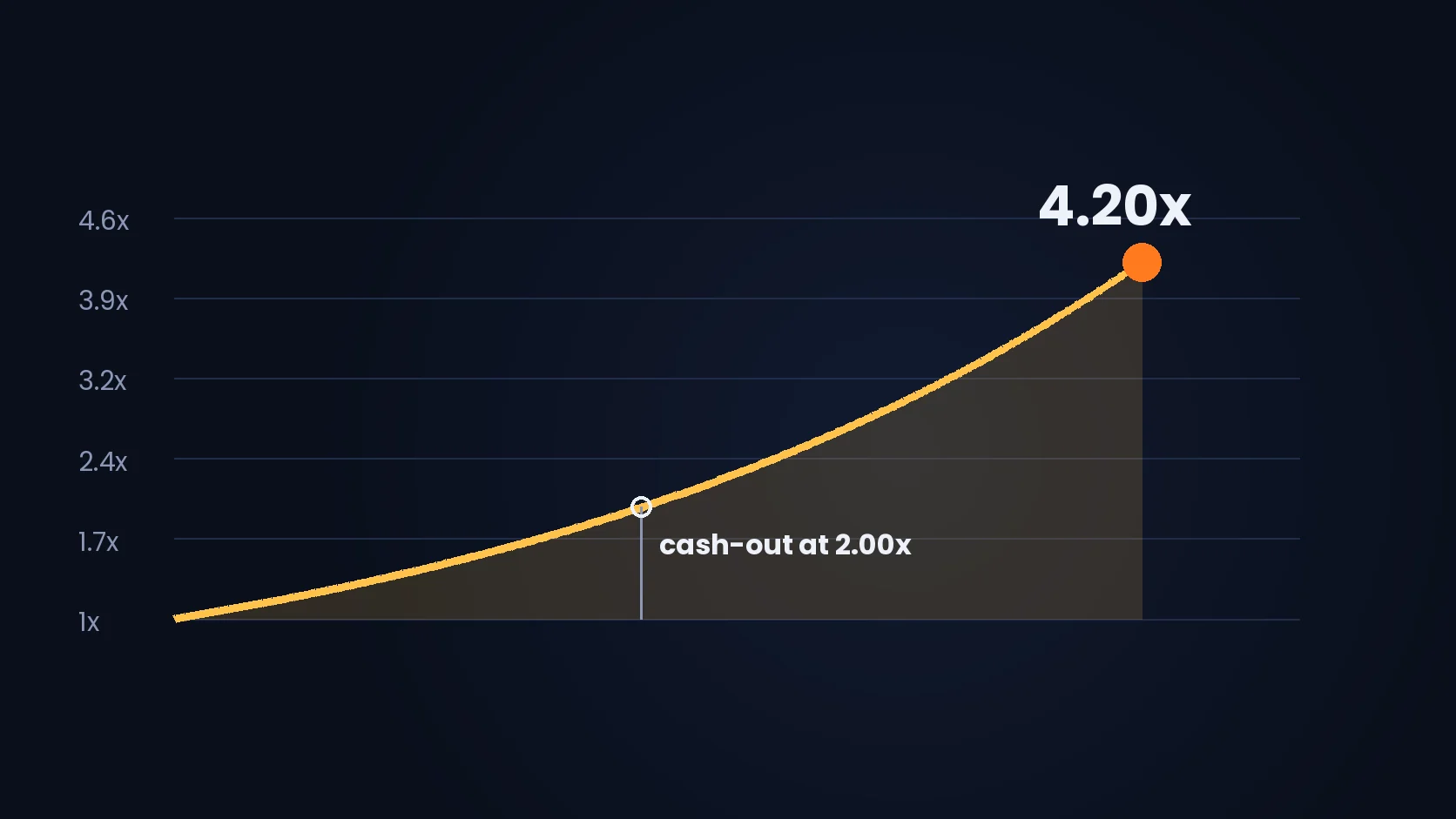
Each round starts with a short betting window. When it closes, the plane takes off and the multiplier rises smoothly from 1.00x, accelerating as it climbs. At a point decided before the round began, the plane flies away and the multiplier stops. Anyone who pressed cash-out before that moment wins the stake multiplied by the value shown at the time of cash-out; anyone still in loses the stake. Some rounds end almost immediately at or near 1.00x, while rare rounds run to very high multipliers.
Two bets, auto bet and auto cash-out
The game screen allows two separate bets in the same round, each with its own cash-out button, which is why players often pair a small early cash-out with a riskier late one. An auto bet option repeats the stake each round, and auto cash-out closes a bet at a chosen multiplier without any tap. These tools change how a session feels and how fast it moves, but they do not change the mathematics of any single bet, and auto bet in particular makes it easy to place hundreds of bets without noticing.
Aviator odds and the 97% return
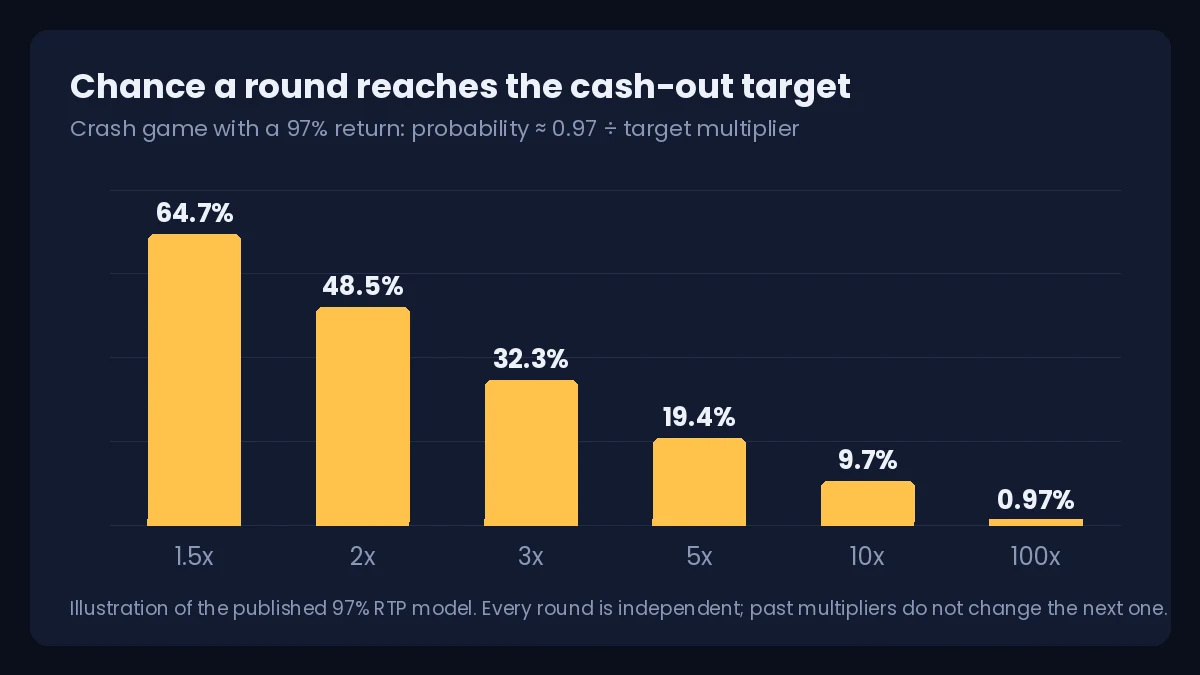
Spribe publishes a return to player of 97% for Aviator, which means that over a very long run the game pays back 97 of every 100 rupees staked and keeps 3. In a crash game built on that figure, the chance that a round reaches a cash-out target is roughly 0.97 divided by the target multiplier. The chart and the table below apply that rule to common targets, using a stake of ₹100:
| Cash-out target | Approximate chance of reaching it | Payout on ₹100 if reached | Average return per ₹100 |
|---|---|---|---|
| 1.5x | 64.7% | ₹150 | ₹97 |
| 2x | 48.5% | ₹200 | ₹97 |
| 5x | 19.4% | ₹500 | ₹97 |
| 10x | 9.7% | ₹1,000 | ₹97 |
| 100x | 0.97% | ₹10,000 | ₹97 |
The probabilities are a model of a 97% crash game rather than figures published round by round, but they follow directly from the stated return. Whatever target is chosen, the average return stays at about ₹97 per ₹100, so the expected cost of playing is about 3% of everything staked, regardless of how cautious or bold the chosen target looks.
Why the cash-out target does not change the return
A low target such as 1.2x wins often and pays little, while a high target such as 20x wins rarely and pays a lot, yet both lose about 3% of the amount staked over time. Choosing a target changes the pattern of results, not their average. A player who cashes out at 1.5x will see long winning streaks punctuated by losses that wipe several wins out at once, which is why low-target play can feel safe right up to the moment it is not. Previous crash points have no influence on the next round, so a history panel full of early crashes says nothing about the round that follows.
How fast the money moves
The 3% edge is smaller than that of many slots, but Aviator rounds last only seconds. At ₹100 per bet and one round every 15 seconds or so, a player can stake around ₹24,000 in an hour, with an expected loss of about ₹720. With two bets per round, both figures double. Speed, not the edge, is what makes crash games expensive, and auto bet removes the natural pause in which a player might otherwise decide to stop. Over an evening of three hours, the same ₹100 stake puts about ₹72,000 through the game.
Provably fair and what it proves
Aviator is described as provably fair, a system borrowed from crypto gambling that lets players check that a round's result was fixed before bets closed and was not altered afterwards. The game menu includes a fairness panel where the data for past rounds can be inspected, and the method is the same on every site that runs the game, since it belongs to the studio rather than to the casino.
Server seed and client seeds
According to the game's fairness description, the operator's server generates a seed for each round and shows its hash in advance, and the client seeds of the first players to bet in that round are combined with it. The crash point is calculated from the combined value with a published hashing method, so after the round anyone can recompute it and confirm that it matches. Because the result depends partly on seeds from several players, neither the server alone nor any single player can choose where the round ends.
What verification cannot tell you
Provably fair checks prove that a round was not changed after the fact, nothing more. They say nothing about whether the site running the game is the genuine product, whether a casino will pay out a withdrawal, or whether an account will be closed after a large win. Fake copies of Aviator on unlicensed sites can show a fairness panel that verifies nothing at all. The check is a feature of the original game, not a guarantee about the operator in front of the player, and it cannot replace a licence check.
Aviator predictors, signals and fake apps
Because the crash point is fixed by seeds combined at the start of each round, no app, bot or Telegram channel can see it in advance. Even so, a large market has grown around the idea that it can be predicted, and it is aimed squarely at Indian players. The most common versions of the scam follow a few familiar patterns:
- predictor apps installed as APK files that claim to read the next multiplier and often steal login details or UPI data instead;
- paid signal groups on Telegram or WhatsApp that post targets after the fact and show only the winning calls;
- hacked or modded versions of the game that are really clones run by the scammers themselves;
- influencer videos showing large wins on demo accounts or sites that pay the creator for every sign-up.
Anyone selling certainty in a random game is selling the scam itself. The only figure that holds is the published return, and it means a steady loss of about 3% of every rupee staked over time. Reporting such groups and apps on the National Cyber Crime Reporting Portal at cybercrime.gov.in or on the 1930 helpline helps others avoid them.
Aviator strategies that circulate online
Most strategy videos recommend one of a few systems: doubling the stake after every loss, cashing out at a fixed low multiplier, or waiting for a run of early crashes before betting. None of them changes the expected return. Doubling after losses turns a small edge into a small chance of a very large loss, because a run of eight or ten early crashes, which happens regularly over thousands of rounds, pushes the stake beyond any normal budget or the table limit. Waiting for a pattern assumes the game has memory, which it does not.
A fixed low target, such as cashing out at 1.3x every time, simply chooses frequent small wins and occasional larger losses at the same 3% cost. The one approach that genuinely controls the outcome of a session is deciding in advance how much money and time it may take, and stopping when either limit is reached. Everything else rearranges the timing of losses without making them smaller.
Where Aviator appears and the legal position in India
Aviator is offered by a large number of offshore casinos, including several of the brands reviewed on this site, and many of them also run similar crash games of their own, such as BC.Game's Crash. In India, though, any version played for real money now falls inside the national ban. Running such a game exposes an operator to a prison term of as much as three years and a fine reaching ₹1 crore, promoting it carries as much as two years and ₹50 lakh, and no bank or payment app is allowed to handle the money.
The government had blocked well over eight thousand betting and gambling domains by spring 2026, yet copies of Aviator sites reappear under new domains every week. Payments to them usually go through third-party accounts rather than to the operator, which leaves a player with no protection and no Indian authority to complain to. The casino reviews describe how the main offshore brands operate, and the home page sets out the legal background in full.
Keeping control in a fast game
Crash games compress a long casino session into a few minutes, which makes limits more important than in almost any other format, since a hundred bets can pass before a player has really noticed how much has been spent. A few simple habits slow the game down and make a decision to stop much easier to keep:
- set a fixed amount for the session before the first round and never top it up;
- turn off auto bet so that every stake needs a deliberate tap;
- take a break of several minutes after every twenty rounds;
- never place a bet to recover money already lost.
If a few minutes of Aviator regularly turn into hours, or money meant for rent, fees or bills goes into it, that is a clear sign to stop and talk to someone, because the pace of the game makes losses grow faster than most players expect, and hiding the habit from family is one of the most common early warning signs.
Help costs nothing. Calling 14416 reaches Tele-MANAS, a government mental health service with counsellors who speak many Indian languages, while Gamblers Anonymous groups meet in person in the larger cities. Practical tools, such as blocking apps that stop crash game sites from loading on a phone, are collected on the responsible gambling page.
Frequently asked questions about the Aviator game
Spribe publishes a return to player of 97% for Aviator. Over a very long run the game pays back about ₹97 of every ₹100 staked, so the expected cost is about 3% of the total amount bet.
No. The crash point is calculated from seeds combined when the round starts, and no app or signal group can see it in advance. Predictor apps and paid signals are scams, and many APK versions also steal login or payment details.
Aviator was released in 2019 by Spribe, a game studio founded in 2018 and licensed by regulators including the UK Gambling Commission and the Malta Gaming Authority. Casinos license the game from the studio.
No. Real money Aviator is an online money game under the Promotion and Regulation of Online Gaming Act, 2025, which bans offering, advertising and processing payments for such games. Its rules have been enforced since 1 May 2026.
An early target wins more often but pays less, and the average return stays at about 97% whatever target is chosen. Low targets only change the pattern of results, with frequent small wins and occasional losses that cancel several of them.
It means the result of each round can be recalculated after it ends from the server seed and the players' client seeds, proving it was fixed before bets closed. It does not show whether a site is genuine or whether it will pay out.